

 Bianca Babaians
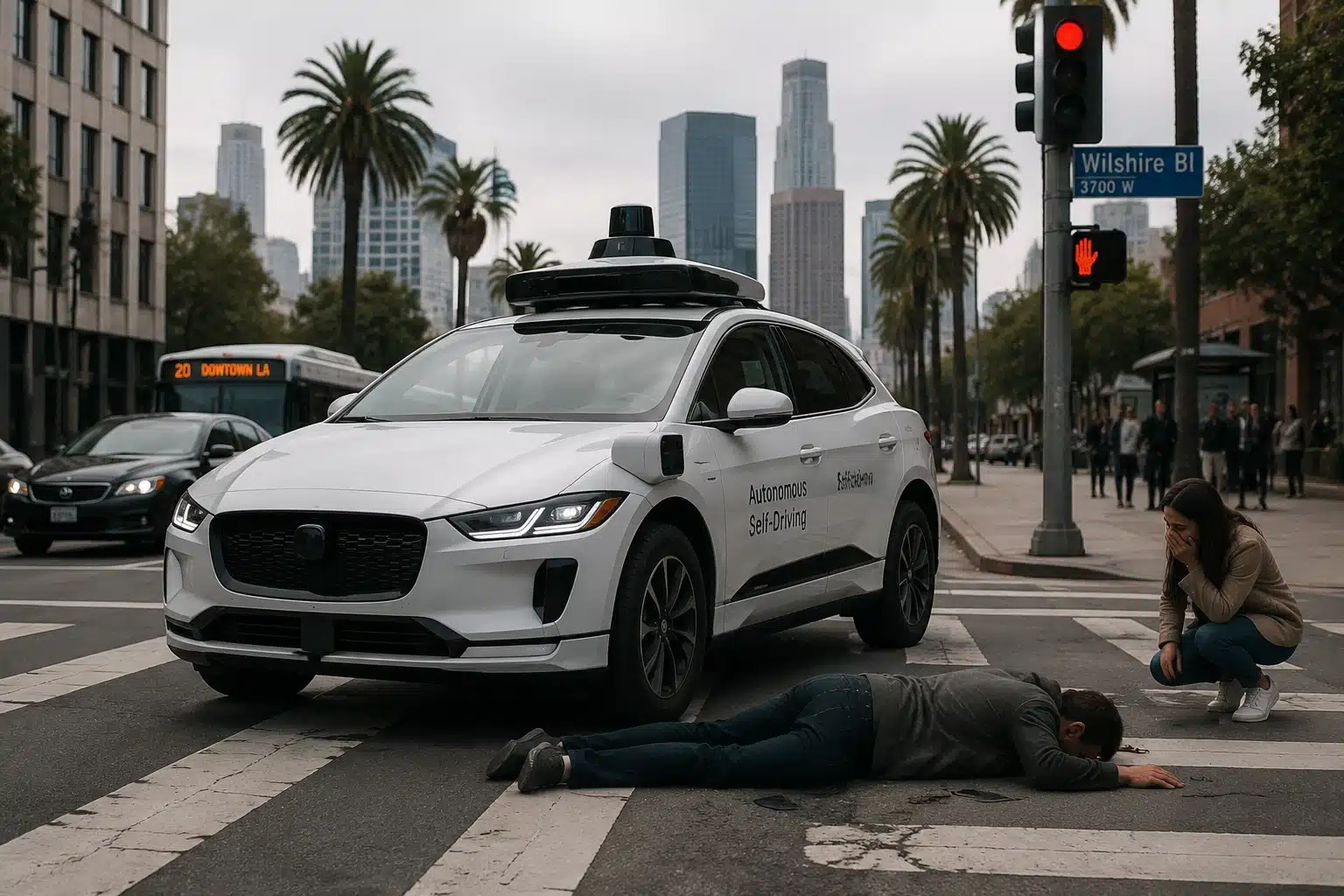
At Babaians Law Firm, we know California’s Vehicle Code defines an “operator” of an autonomous vehicle as whoever is in the driver’s seat, or, if no one is, whoever causes the autonomous technology to engage. When a fully driverless car hits a pedestrian, that operator role sits with the company running the fleet, not a human passenger. The manufacturer, defined by statute as whoever equipped the vehicle with the autonomous technology, carries separate responsibility for how the system was built and tested. Our pedestrian accident practice area covers exactly this kind of claim.
That matters for a pedestrian’s claim in a very practical way. To even operate on California roads without a driver, a manufacturer must certify to the DMV that it holds at least a five million dollar insurance policy, surety bond, or proof of self-insurance. That is a substantially larger pool than a minimum personal auto policy, and it exists before the vehicle ever leaves the lot.
A number of new duties. According to the chaptered bill text published by the California Legislature, under the version of Vehicle Code section 38751 that became operative July 1, 2026, any manufacturer running vehicles without a human operator physically present must maintain a dedicated emergency response telephone line, staffed so that a remote human operator picks up within 30 seconds. Each vehicle must also carry a two-way voice device so first responders standing next to it can reach that remote operator directly. If an emergency official issues a geofencing message, the manufacturer has two minutes to route its fleet out of the area.
Separately, the law creates a “notice of autonomous vehicle noncompliance” that a peace officer can issue when an autonomous vehicle breaks a traffic law while its self-driving technology is engaged, with the manufacturer required to report that notice to the DMV within 72 hours. The statute itself says this ticketing framework only takes effect once the DMV adopts implementing regulations, and the California DMV’s own announcement of its new autonomous vehicle regulations confirms those regulations are now in place, enabling officers to cite AV operators for moving violations.
For a pedestrian who was hit, each of these is a measurable standard. Did the operator’s remote line answer in 30 seconds? Was there a noncompliance notice tied to the same incident? Those are no longer vague questions. They are yes-or-no facts a manufacturer has to answer.
More than most people expect, and it is legally required to exist. Under Vehicle Code section 38750, a manufacturer must certify that its autonomous vehicle captures and stores sensor data covering at least the 30 seconds before any collision, in a read-only format, and preserves it for three years after the crash date. That is not a company policy that can change. It is a state requirement tied to the vehicle’s permit to operate.
Practically, that means the vehicle itself has a locked, unalterable record of what its sensors saw and what the system decided in the moments before impact. The open question is not usually whether the data exists. It is whether someone formally demands the manufacturer preserve and produce it before an unrelated dispute or delay lets the three-year window quietly work against you. A preservation letter sent early by our Los Angeles pedestrian accident attorneys is what locks that record to your specific incident.
There is no simple yes or no, and treating it as one misses what actually matters for a claim. Autonomous vehicles from operators like Waymo are expanding rapidly across Los Angeles, and the state’s own permitting rules exist because the technology’s failure modes are still being tested against real city streets, real crosswalks, and real pedestrians. A Waymo or other autonomous vehicle incident is not inherently more or less winnable than a human-driven crash. It simply runs on different rules, with a different kind of evidence and a different kind of defendant. That is exactly why pedestrians in LA are asking this question for the first time and why most published answers so far are thin.
Treat the medical side exactly as you would after any serious collision. Get checked out even if you feel able to walk away, since head and soft-tissue injuries can take days to appear. Note the exact time, location, and, if visible, the operator’s name on the vehicle. Ask responding officers for the report number, and if they mention a notice of autonomous vehicle noncompliance, ask that it be documented.
Then contact an attorney before speaking with the operator’s claims team. What you say in that first conversation can be used to minimize what you recover, and the operator has no independent obligation to volunteer that a noncompliance notice was issued or that its sensor data supports your version of events. California’s general deadline to file a personal injury claim is two years, but the useful window for locking down evidence is much shorter than that.
Founder Bianca Babaians, Esq. started this firm after watching her own mother get hurt and then abandoned by attorneys who would not fight for her, and that history still shapes how every case here is handled.
If you or someone you love was a pedestrian hit by a driverless car anywhere in the Los Angeles area, do not assume the claim is too new or too complicated to pursue. Speak with a Los Angeles pedestrian accident lawyer at Babaians Law Firm. Call (818) 334-2981 or contact us online for a free, no-obligation consultation. The sooner we can send a preservation letter, the more of the vehicle’s record we protect for your case.
Generally the vehicle’s manufacturer and operator, both defined under California law, rather than a driver. Manufacturers must carry at least five million dollars in insurance, bond, or self-insurance to operate driverless vehicles, which is often far more coverage than a standard auto policy.
As of July 1, 2026, manufacturers running vehicles without a human operator must staff a first-responder line answered within 30 seconds, equip vehicles with a two-way communication device, and clear a geofenced emergency zone within two minutes of an alert. A separate noncompliance notice system, now enabled by DMV regulations, lets officers cite an autonomous vehicle for a traffic violation.
State law requires manufacturers to capture at least 30 seconds of sensor data before any collision, store it in an unchangeable read-only format, and keep it for three years. A prompt preservation letter helps make sure that specific record is tied to your incident.
The honest answer is that it depends on the operator, the location, and the specific incident, which is exactly why California requires manufacturers to meet insurance, testing, and data-retention standards before operating without a driver. Those standards are also what a claim after a crash is measured against.
The general deadline for a California personal injury claim is two years from the date of the injury. Confirm your specific deadline with an attorney quickly, since the vehicle’s sensor data and any noncompliance notice are easier to secure early.
We take on fewer cases to give every client the focus they deserve. Unlike high-volume firms where cases get lost in the shuffle, we prioritize quality over quantity, delivering the attention and results your case deserves. Experience the difference with our dedicated team.
Great female led personal injury firm with good results and settlements. I highly recommend this law firm for personal injury related matters in Los Angeles and California in general.
Rho G


