

 Bianca Babaians
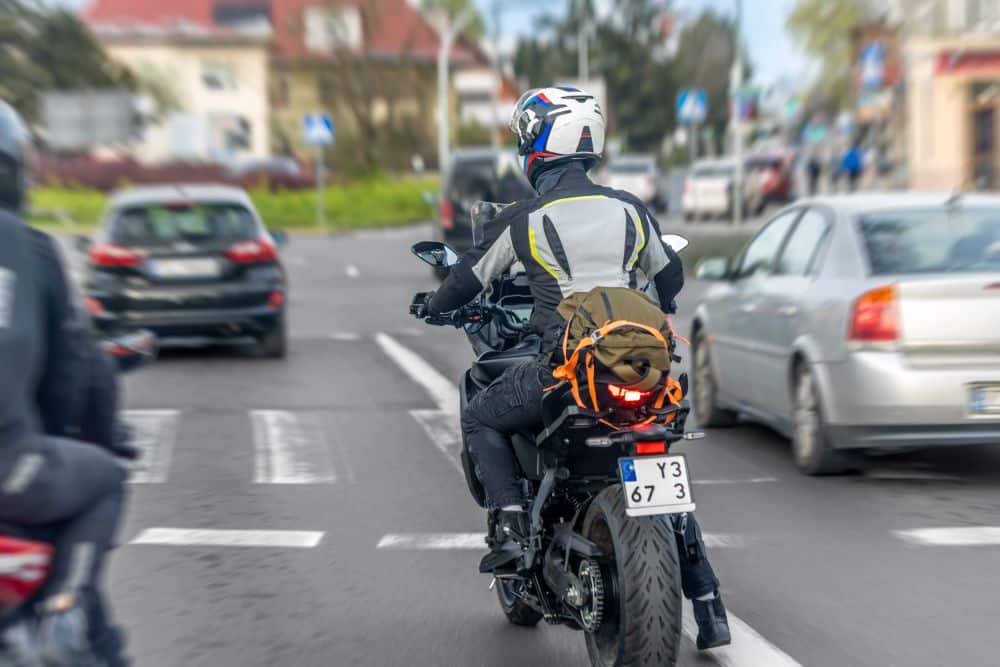
California Vehicle Code 21658.1 defines lane splitting as riding a two-wheeled motorcycle between rows of stopped or moving vehicles in the same lane, and lets the CHP publish safety guidelines for it. Lane splitting is legal in California. The statute itself does not set a numeric speed limit or a maximum speed differential between the motorcycle and surrounding traffic.
Instead, the California Highway Patrol has published he California Highway Patrol has published safety tips for riders. That guidance is not itself law, which is a distinction insurance adjusters do not always explain accurately when they evaluate a claim.
At Babaians Law Firm, our motorcycle accident attorneys see how often lane splitting gets misunderstood after a crash, so it is worth stating the law plainly before anything else.
Lane-splitting risk is not evenly distributed across the county. It concentrates wherever stop-and-go congestion is worst, because that is exactly the condition that makes splitting attractive to riders and dangerous for everyone nearby. The 405 through the Sepulveda Pass, the 101 through Hollywood and the Valley, the 10 through downtown and the Westside, and the 134 through Glendale and Pasadena all see heavy rush-hour crawl and all show up repeatedly in local collision reports involving motorcycles.
Surface streets create a different pattern. Riders splitting between lanes near freeway on-ramps and off-ramps face drivers who are actively merging, checking mirrors for cars rather than motorcycles, and making last-second lane changes to catch an exit. Intersections near freeway interchanges combine both risks at once, since traffic often backs up from the ramp itself.
Time of day matters as much as location. Morning and evening rush hour produce the density that makes lane splitting both more common and more dangerous since visibility narrows and driver attention fragments across multiple mirrors, phones, and following distances. A driver who would normally check a side mirror before changing lanes in light traffic may skip that step during heavy congestion, assuming the lane next to them is simply another line of stopped cars rather than open space a motorcycle might be using. None of this changes the underlying legal analysis.
Comparative negligence still applies the same way whether a crash happens on a Los Angeles freeway during rush hour or on a quiet residential street. What it does affect is the kind of evidence available afterward, since freeway corridors are more likely to have traffic camera coverage, Metro or Caltrans sensors, and other vehicles with dash cameras that can corroborate a rider’s account.
California follows a pure comparative negligence rule, meaning fault can be divided between every party involved in a crash, and a rider is not barred from recovery just because they hold some percentage of blame. If a rider were lane splitting at the time of a collision, an insurer would often argue the rider bears significant fault regardless of what the other driver did. In practice, fault is rarely all or nothing, which is exactly why any motorcycle accident lawyer Los Angeles riders consult should review the police report before an insurer’s version of events is accepted.
A driver who changed lanes without checking a mirror, opened a door into traffic, or made an unsafe left turn can carry the majority of the fault even when a rider was lane splitting at the time. Under California’s pure comparative negligence system, a rider found 30 percent at fault still recovers the remaining 70 percent of their damages from the other party, rather than losing the claim entirely.
Myth: Lane splitting means the rider is automatically at fault. Reality: fault is determined by the actual facts of the collision, not by the fact that lane splitting was occurring.
Myth: Accepting the first settlement offer is the fastest way to move on. Reality: early offers are often calculated before medical treatment is complete, which tends to undervalue the claim.
Myth: A recorded statement to the other driver’s insurer is required right away. Reality: riders are not obligated to give a recorded statement to another party’s insurer before speaking with an attorney.
Adjusters handle a high volume of claims, and lane-splitting cases fall into a pattern they recognize immediately: mention that the rider was between lanes, and many claimants simply accept a reduced offer without pushing back. Several tactics show up often enough to be worth naming directly.
The first is framing questions during a recorded statement to elicit an admission rather than a neutral account. A question like how fast were you going between the cars invites a specific number that can later be compared unfavorably to CHP guidance, even when that guidance is not itself a legal speed limit. Riders are not required to give a recorded statement to the other driver’s insurer at all, and doing so before speaking with an attorney routinely works against the person who was hurt rather than the person who caused the crash.
The second is moving quickly with an early settlement offer, often before medical treatment is complete or imaging has identified a soft tissue or spinal injury that did not show up right away. An early number can look reasonable in isolation, but it rarely accounts for treatment still in progress, let alone future care.
The third is treating a rider’s own dash camera or helmet camera footage as evidence of fault by focusing only on the moment the rider was between lanes, rather than the seconds immediately before impact when the other driver’s lane change or turn actually occurred. Footage that shows the full sequence, not an isolated clip, is what actually clarifies fault, and that context matters more than a single freeze-frame an adjuster chooses to highlight.
Not sure how comparative negligence applies to your specific crash? Don’t accept an insurer’s first explanation of fault. Call (818) 334-2981 for a free consultation with Babaians Law Firm. We can walk through the actual facts of your case before you say anything else to an adjuster.
Because insurers default to treating lane splitting as a fault signal, the evidence gathered after a crash carries more weight for riders than it typically does for drivers in a standard two-car collision. A few categories consistently make the biggest difference in how a claim resolves.
Video footage sits at the top of the list. Helmet cameras, motorcycle-mounted dash cameras, and footage from nearby vehicles or storefronts can establish exactly when the other driver moved without signaling or checking a mirror. Traffic camera systems along major corridors, along with camera coverage from adjacent businesses, are also worth requesting quickly, since retention windows for that footage are often short.
The official collision report matters as well. A CHP or local police report documents officer observations at the scene, witness contact information, and often a preliminary assessment of contributing factors. That report is not the final word on fault, but it becomes a reference point every subsequent negotiation returns to, which is why inaccuracies in it are worth correcting early rather than after a claim is already underway.
Vehicle data can also help. Many modern cars retain limited event data, including speed and braking information in the seconds before a collision, and that data can either support or undercut an insurer’s version of events. Witness statements collected close to the time of the crash tend to be more reliable than statements gathered weeks later, since memory of exact timing and lane position fades quickly.
Finally, a rider’s own medical records, tied clearly to the date of the crash, close the loop between the collision and the injuries being claimed, which matters because insurers frequently argue that a gap between the crash and treatment suggests the injury came from somewhere else.
None of this evidence has to be gathered alone. Part of what a motorcycle accident lawyer does in the days after a crash is send preservation letters to nearby businesses and public agencies before footage is overwritten, request the full collision report once it is finalized, and identify which pieces of evidence actually move the needle on a specific claim rather than treating every case the same way.
Documentation matters more for riders than for most drivers, because insurers already start from an assumption of rider fault.
Founder Bianca Babaians, Esq. built this firm after watching her own mother get hurt and then treated as an afterthought by attorneys who would not fight for her, and that experience still shapes how every case is handled here.
A personal mission, not just a job. Bianca built this firm around the promise that no client would feel dismissed the way her mother did, so every case gets her direct attention.
We push back on assumed fault. Insurers frequently treat lane splitting as an admission of fault. We challenge that assumption with the actual facts of the crash, not the industry’s shortcut.
California licensed since 2015. Bianca Babaians, Esq. is a Super Lawyers Rising Star and was named to the National Trial Lawyers Top 40 Under 40.
No cost unless we win. Consultations are free, and you owe nothing in attorney fees unless we recover compensation for you.
If you were hurt while lane splitting and are being told that alone means you were at fault, get a second opinion before you accept it. Speak with a motorcycle accident lawyer at Babaians Law Firm. Call (818) 334-2981 or contact us online for a free, no obligation consultation. Explore related guidance on our motorcycle accident practice area page.
Yes. Vehicle Code 21658.1 recognizes lane splitting between stopped or moving vehicles and lets the CHP publish safety guidelines; the law sets no fixed speed limit.
No. California’s pure comparative negligence rule allows a rider to recover a reduced percentage of damages even if found partly at fault, rather than being barred from recovery entirely.
Fault is based on the specific facts of the collision, including the other driver’s actions, not on the presence of lane splitting alone.
No. Riders are not required to provide a recorded statement to another party’s insurer before consulting an attorney.
California’s personal injury statute of limitations generally allows two years from the date of the crash, though shorter deadlines apply if a government entity is involved.
We take on fewer cases to give every client the focus they deserve. Unlike high-volume firms where cases get lost in the shuffle, we prioritize quality over quantity, delivering the attention and results your case deserves. Experience the difference with our dedicated team.
Great female led personal injury firm with good results and settlements. I highly recommend this law firm for personal injury related matters in Los Angeles and California in general.
Rho G